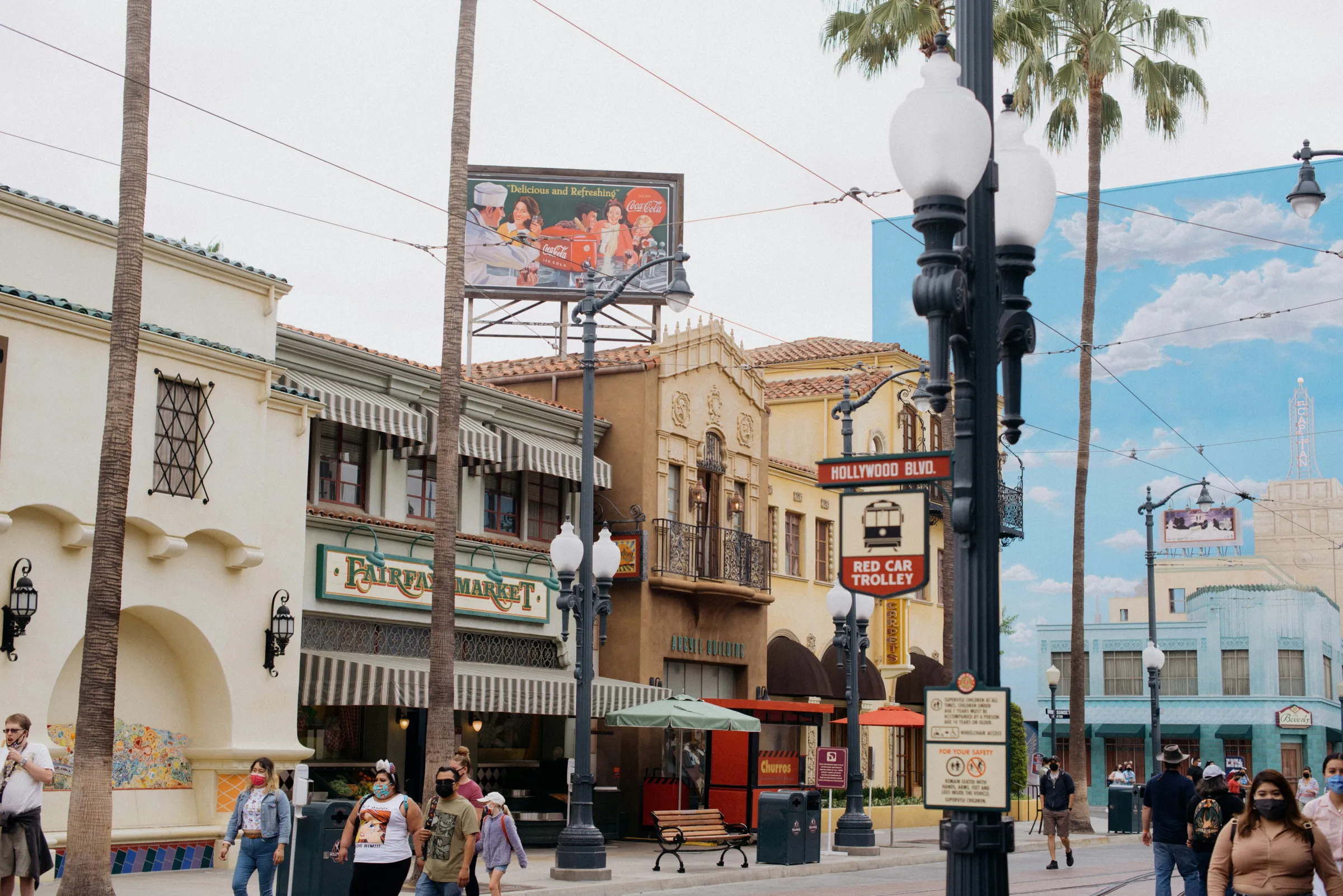
Anaheim is one of the largest and most diverse cities in Orange County, located in the north-central part of the county. It functions as a major residential hub, tourism destination, and regional employment center, which makes it one of the most complex and multi-layered real estate markets in Southern California.
While many cities in Orange County are defined by a clear architectural identity or master-planned design, Anaheim developed gradually over time. As a result, it is not a uniform suburban environment, but rather a patchwork of very different neighborhoods that evolved under different economic cycles, zoning decisions, and development eras.
Most people know Anaheim for Disneyland Resort and its surrounding entertainment infrastructure, but the actual city extends far beyond tourism. It includes dense urban corridors, quiet residential pockets, industrial-adjacent zones, suburban family neighborhoods, and upscale hillside communities — all within the same city limits.
For buyers and investors, Anaheim is rarely a “lifestyle city” in a traditional sense. Instead, it is a strategy-driven market where success depends on selecting the right micro-location.
Why buyers choose Anaheim
The primary reason buyers consider Anaheim is the combination of affordability and central regional access.
Compared to coastal Orange County cities or newer master-planned communities like Irvine, Anaheim offers a significantly lower entry point while still maintaining strong connectivity to major job centers across both Orange County and Los Angeles County.
Another major advantage is flexibility. Buyers are not limited to a single housing style or price bracket. Anaheim offers everything from entry-level condos to luxury hillside estates, often within a relatively short geographic distance from each other.
The city is also highly attractive for investors. Rental demand remains consistently strong due to its employment base, tourism economy, proximity to major highways, and overall affordability compared to surrounding markets. Many areas near transit corridors and entertainment districts perform particularly well as long-term rental investments.
From a commuting perspective, Anaheim is one of the most functional cities in the region. With direct access to the 5, 57, and 91 freeways, residents can realistically reach multiple employment hubs without being locked into a single direction of travel.
City character and overall structure
Anaheim is structurally fragmented, which is one of its defining real estate characteristics. Unlike master-planned cities that follow a consistent design philosophy, Anaheim evolved in layers across decades.
This creates sharp transitions between neighborhoods — sometimes even within the same few blocks — where housing type, density, and property values can shift noticeably.
In practice, the city is typically understood through five major sub-areas:
West Anaheim, Central Anaheim, East Anaheim, Anaheim Hills, and the Platinum Triangle.
Each of these areas functions almost like a separate micro-market with its own pricing behavior, buyer profile, and lifestyle feel. This internal segmentation is one of the reasons Anaheim is considered one of the most complex housing markets in Orange County.
Housing, architecture, and real estate market
Anaheim’s housing stock reflects multiple eras of California development. The city contains post-war suburban neighborhoods built in the 1950s–1970s, early tract-home communities from the suburban expansion period, and modern high-density redevelopment projects concentrated in specific zones.
Architecturally, there is no single dominant style. Instead, buyers encounter a mix of mid-century ranch homes, Spanish-style remodels, basic stucco tract houses, newer contemporary townhomes, and luxury hillside estates in elevated areas.
This diversity creates opportunity, but also complexity. One of the most important concepts in Anaheim real estate is micro-location sensitivity. Small geographic differences often have a disproportionate impact on pricing.
Key value drivers include school zoning boundaries, proximity to freeways, street-level noise exposure, redevelopment adjacency, and overall neighborhood stability.
Because of this, two homes that appear nearly identical on paper can still have significantly different market values.
Price overview (2026 market)
Current approximate ranges across the city:
- Condos and townhomes: $450,000 – $750,000
- Single-family homes: $750,000 – $1.2M
- Updated homes in stronger neighborhoods: $900,000 – $1.5M
- Anaheim Hills: $1.2M – $2.5M+
- Platinum Triangle condos: $650,000 – $1.3M
Overall, Anaheim remains one of the more accessible large cities in Orange County, especially when compared to Irvine, Newport Beach, or coastal markets where entry prices are significantly higher.
Neighborhoods in Anaheim
West Anaheim
West Anaheim is one of the oldest and most established residential areas in the city. Much of its housing stock dates back to the mid-20th century, giving the area a classic post-war suburban structure. Streets are generally more compact, and housing density tends to be higher than in eastern parts of the city.
The neighborhood is strongly commuter-oriented. Its proximity to the 91 and 5 freeways makes it a practical choice for residents who travel frequently across county lines. The area also has a strong rental component, which contributes to steady investor interest.
Despite its affordability, West Anaheim is highly variable at the street level, meaning that property condition and immediate surroundings play a major role in value perception.
Median home price: approximately $650,000 – $750,000
Central Anaheim
Central Anaheim represents the city’s most urbanized core. This is where residential streets intersect with commercial corridors, entertainment zones, and higher-density housing developments.
The housing stock is dominated by condos, apartments, and mixed-use buildings, creating a more city-like environment compared to traditional suburban neighborhoods. This area is also closer to major attractions and employment centers, which makes it attractive to renters and younger buyers.
Rather than emphasizing space or lot size, Central Anaheim prioritizes accessibility and convenience. It is one of the most transit-friendly parts of the city, with strong connectivity to retail and entertainment infrastructure.
Median home price: approximately $600,000 – $700,000
East Anaheim
East Anaheim is generally considered one of the more balanced and residentially stable parts of the city. It has a stronger suburban feel, with wider streets, more consistent single-family housing, and a noticeably calmer environment compared to central zones.
Many neighborhoods here are owner-occupied, which contributes to long-term stability and a more traditional suburban lifestyle. The area tends to attract families and long-term residents rather than short-term renters.
East Anaheim also benefits from relatively good access to schools and parks, making it a more predictable residential environment within the broader city structure.
Median home price: approximately $850,000 – $950,000
Anaheim Hills
Anaheim Hills is the city’s most upscale residential district, located in the eastern hillside region. It is characterized by larger homes, elevated terrain, and significantly lower density compared to the rest of Anaheim.
Many communities are gated or semi-gated, and homes often feature larger lots, panoramic views, and custom upgrades. The overall environment feels more private and suburban compared to the rest of the city.
The tradeoff is geography. Anaheim Hills is farther from major freeway corridors and central employment hubs, which can result in longer commute times depending on destination.
Median home price: approximately $1.4M – $1.6M
Platinum Triangle
The Platinum Triangle is one of the most rapidly evolving districts in Anaheim. It is a high-density redevelopment zone located near major sports, entertainment, and employment centers.
Over the past decade, the area has transitioned from underutilized land into a modern urban district filled with new condominiums, apartment complexes, and mixed-use developments. This transformation is still ongoing, making it one of the most dynamic parts of the city.
The lifestyle here is notably more urban than elsewhere in Anaheim, with a stronger emphasis on walkability, amenities, and modern residential design.
Median home price: approximately $750,000 – $850,000
Location, transportation, and accessibility
Anaheim’s geographic position is one of its strongest structural advantages.
It sits at the intersection of three major freeway systems: the 5, 57, and 91, which collectively connect Orange County to Los Angeles County, the Inland Empire, and coastal regions.
This creates unusually flexible commuting patterns. Residents are not locked into a single employment corridor, which increases long-term livability for multi-region workers.
Approximate commute times:
- Irvine: 20–35 minutes
- Los Angeles: 30–60 minutes depending on traffic
- Huntington Beach: 25–35 minutes
- John Wayne Airport: 20–30 minutes
- Disneyland Resort area: 10–15 minutes depending on location
Lifestyle and urban environment
One of Anaheim’s defining characteristics is its internal diversity of lifestyles.
The city simultaneously contains dense urban environments, suburban residential zones, hillside communities, and entertainment-driven districts. This means that lifestyle experience varies dramatically depending on where a resident lives.
There is no single downtown core. Instead, activity is distributed across multiple nodes, including retail corridors, entertainment districts, and neighborhood commercial centers.
Anaheim also functions as one of the strongest entertainment and tourism-driven economies in Orange County, which influences both employment and local infrastructure development.
Schools and education
School zoning in Anaheim is highly segmented and depends heavily on location.
The city is served by multiple school districts, including Anaheim Union High School District, Orange Unified School District, and Magnolia School District. Because boundaries are complex and vary by neighborhood, school assignment is one of the most important factors in home valuation.
In general, eastern neighborhoods and Anaheim Hills tend to be associated with stronger school performance and more family-oriented environments, while more central areas show greater variation.
Shopping, dining, and daily life
Daily life in Anaheim is highly location-dependent, with different districts offering different lifestyle experiences.
Key destinations include the Anaheim Packing District, which is a popular dining hub, the Anaheim GardenWalk entertainment area, and major retail corridors along Harbor Boulevard and Katella Avenue.
The city offers a wide range of dining options, shopping centers, entertainment venues, and event-based attractions. Because of its tourism infrastructure, Anaheim has a higher concentration of restaurants and entertainment options than many similarly priced inland cities.
Anaheim vs nearby cities
Anaheim vs Irvine
Irvine is a highly structured, master-planned city with uniform design, strong schools, and significantly higher pricing. Anaheim is more diverse, older, and less predictable, but offers better affordability and broader investment opportunities.
Anaheim vs Fullerton
Fullerton has a stronger historic identity, a more defined downtown core, and a college-town atmosphere. Anaheim is larger, more economically diverse, and more fragmented in structure.
Anaheim vs Orange
Orange is more traditional and stable, with stronger preservation of suburban character and historic neighborhoods. Anaheim is more dynamic, denser, and significantly more varied across micro-markets.
Pros and cons
Pros
Anaheim offers one of the most accessible entry points into Orange County real estate while maintaining strong regional connectivity. It has diverse housing options, strong rental demand, and excellent freeway access. Its economic base is supported by both employment centers and tourism infrastructure, which creates long-term stability in housing demand.
Cons
The city’s biggest challenge is inconsistency. Neighborhood quality, school performance, and street-level environment can vary significantly within short distances. Central areas also tend to be denser, and the city lacks a unified identity or centralized downtown core.
Who lives in Anaheim
Anaheim attracts a broad and diverse population, reflecting its economic and geographic positioning within Orange County.
Residents include commuters working in both Los Angeles and Orange County, first-time homebuyers seeking affordability, real estate investors targeting rental demand, families looking for suburban environments (especially in Anaheim Hills and eastern neighborhoods), and younger renters drawn to central and redevelopment areas.
Final thoughts
Anaheim is best understood not as a single real estate market, but as a collection of interconnected micro-markets operating under one city name.
It offers no single dominant lifestyle, but instead provides range — from entry-level affordability to upscale hillside living and modern urban redevelopment.
For buyers, the key insight is that Anaheim is not about the city itself, but about precision within the city. The right neighborhood choice has a greater impact than almost any other factor in the transaction.